Security Guards for Apartments & Gated Communities in Bangalore: The Complete RWA Guide
A complete guide for Bangalore RWAs on apartment and gated-community security: what a professional deployment covers, how many guards you need, PSARA compliance, common security gaps, and how to choose the right agency.
Securing an apartment complex or gated community is one of the most scrutinised decisions an RWA committee ever makes, and rightly so. Your security team decides who enters your community, manages an endless flow of visitors, delivery riders, domestic staff and drivers, keeps the gates and parking disciplined, and becomes the first responder when something goes wrong at two in the morning. Get it right and residents barely notice the machine running behind them. Get it wrong and you have safety gaps, frustrated owners in the next general body meeting, and liability the committee never agreed to carry.
This guide is written specifically for Bangalore RWAs and apartment associations. It covers what a professional residential security deployment actually looks like, how it differs from corporate security, how many guards your community really needs, the compliance you cannot compromise on, the security gaps we see most often in Bangalore apartments, and exactly how to choose an agency you can trust with your residents' safety.
Why residential security is different from corporate security
It is tempting to assume a good corporate security agency will do just as well at an apartment complex. In practice, residential security is a different discipline.
A corporate site is a controlled, largely nine-to-five environment with a known workforce, ID cards and a facilities team. A gated community is a 24/7 living environment: residents come and go at all hours, children play in common areas, domestic help and drivers arrive daily, e-commerce and food deliveries never stop, festivals bring gatherings and outside vendors, and emergencies do not keep office hours. On top of that, your guards answer not to a single facilities manager but to a committee of residents, each with their own expectations.
Residential security therefore demands a blend of firm access control, genuine service, and quiet discretion that corporate deployments rarely need. An agency whose experience is purely corporate will often under-appreciate the visitor volume, the delivery chaos, and the sensitivity of working around families. When you evaluate agencies, weight residential and gated-community experience heavily.
What a professional apartment security deployment covers
A residential guard is far more than someone at the gate. A well-run deployment for a Bangalore apartment or gated community covers all of the following:
Visitor management. Verifying and logging every visitor, confirming with the resident before allowing entry, handling pre-approved guests, and increasingly doing all of it through a digital visitor-management app rather than a paper register that nobody audits.
Gate and access control. Operating the boom barrier, checking resident stickers and passes, and actively stopping tailgating, which is the single most common way unauthorised people get inside a community.
Delivery and e-commerce management. A dedicated approach to the flood of couriers and food riders, so parcels are logged and delivery staff are verified instead of wandering the towers unescorted.
Domestic staff and driver management. ID checks and in-and-out logging for the maids, cooks, drivers and vendors who enter daily, which is where most residential communities are quietly exposed.
Vehicle movement and parking discipline. Directing traffic at peak hours and enforcing parking rules that residents themselves will not police.
Patrolling and surveillance. Scheduled rounds of the clubhouse, gym, pool, parking basements, terraces, fire exits and perimeter, plus active CCTV monitoring where cameras exist.
Emergency first response. Trained response to fire, a medical emergency, a lift entrapment, an intrusion or a natural event, including who to call and how to guide help in.
Reporting and coordination. Documented incident reports the committee can actually review, and day-to-day coordination with the RWA and facility manager.
If an agency cannot describe this scope in detail, they are selling you a body at a gate, not security for your community.
How many security guards does your community actually need?
Headcount is where committees either overspend or leave dangerous gaps, and it is driven by your layout rather than any fixed formula:
Active gates. Every gate that stays open needs a manned post. A community with two working gates needs at least two posts.
Cover hours. A single post covered around the clock needs three shifts, which means more than one guard once weekly-offs and relief are counted, so a post is never left empty.
Patrolling. Larger communities need roving guards for basements, terraces, amenities and the perimeter, on top of the gate posts.
Amenity and clubhouse posts. Pools, gyms and event spaces may need dedicated cover at peak times.
Supervision. Once you cross roughly six guards on site, a shift-in-charge or supervisor is what keeps standards from drifting.
The honest answer for any specific community comes from a proper site survey that maps gates, blind spots, peak visitor windows and resident routines. Under-staffing saves effort until the night a gate sits unmanned; over-staffing quietly drains the maintenance fund without adding real safety.
PSARA licensing and police verification: the residential non-negotiable
Every private security agency operating in Karnataka must hold a valid licence under PSARA, the Private Security Agencies (Regulation) Act, 2005 (the Act), issued by the state Controlling Authority, and reputable agencies are also listed with industry bodies such as the Karnataka Security Services Association. Under that framework, guards must be police-verified before they are ever deployed.
For a residential community this is the heart of the decision, not a formality. Your guards have standing access to residents, their homes, their vehicles and their children. An agency that cannot produce a licence number and police-verification records for its guards is asking you to place unvetted strangers inside your gates, indefinitely. There is also a liability dimension: when your RWA engages an agency, the committee effectively becomes the principal employer of those guards, so a non-compliant agency can push wage, statutory and incident liability straight back onto the association. Before signing with anyone, work through our guide on how to verify a security agency's PSARA licence.
Common security gaps in Bangalore apartments, and how to close them
Across Bangalore communities, the same weaknesses show up again and again. Knowing them lets your committee ask the right questions:
Tailgating at the gate. Visitors and delivery riders slip in behind residents' cars. The fix: trained gate discipline, a boom barrier, and a guard empowered to stop and verify.
Delivery and visitor chaos. Peak-hour crowds overwhelm a single guard. The fix: a visitor-management app, a parcel desk, and adequate peak-time staffing.
Unverified domestic staff. Maids, cooks and drivers enter daily with no record. The fix: ID capture and in-and-out logging for all daily-help.
Night-shift complacency. The most vulnerable hours get the least attention. The fix: supervised night patrols with checkpoint scans, not a guard asleep at the gate.
Unpatrolled basements and terraces. These blind spots are where incidents happen. The fix: scheduled patrolling routes that cover them.
Guard fatigue and double shifts. Overworked guards are unsafe guards. The fix: proper rostering, weekly-offs and a floating relief pool.
High turnover. Constant new faces mean nobody knows the residents or the routines. The fix: an agency with fair wages and low attrition.
No supervision or accountability. Without a supervisor and written reports, standards drift within weeks. The fix: a named shift-in-charge and documented reporting to the committee.
A good agency will already have an answer for every one of these before you ask.
Technology that supports, not replaces, your guards
Many committees ask whether CCTV and a visitor app can replace guards. They cannot. Cameras, boom barriers, RFID stickers, intercoms, panic buttons and visitor-management software are force multipliers, not substitutes: a camera records what happened, a trained guard prevents it and responds in the moment. The strongest residential setups run manned guarding as the backbone with technology layered on top, and treat the two as partners rather than alternatives.
What shapes your community's security requirement
Rather than a one-size quote, a professional agency scopes your deployment around your community: its size and number of towers, how many gates stay active, whether you need round-the-clock or daytime cover, the patrolling and amenity posts required, your visitor and delivery volume, and the compliance standard you expect. The right way to understand what your community needs is a tailored assessment rather than a phone quote, so you are comparing like for like across agencies.
Questions every RWA should ask before signing
Put every agency through the same checklist and the real quality of each proposal becomes obvious:
1. Are you PSARA-licensed in Karnataka? Ask for the licence number and certificate.
2. Are guards police-verified before deployment? Non-negotiable for a residential community.
3. Are ESI and PF filed monthly for every guard? Ask to see recent challans.
4. What is your replacement time when a guard is absent? One hour is a good benchmark.
5. Who supervises the post, and how is it documented? Expect a named supervisor and written reports.
6. Do you have real experience with gated communities and RWAs? Residential operations differ from corporate.
7. Do you use digital visitor management and reporting? Paper registers are a liability.
8. Can you share references from other Bangalore societies? A confident agency will.
For the wider decision framework, see our guide to choosing a security guard agency in Bangalore.
Why the cheapest quote puts your community at risk
A quote that undercuts everyone is rarely efficiency, it is unmanaged risk. An agency that skips ESI and PF, underpays its guards, or deploys people who are not police-verified quietly transfers that liability onto the association, and it is the committee, not the vendor, that answers to residents when something goes wrong. A single incident involving an unverified guard, or one labour inspection, can cost a community far more in money and trust than any apparent saving. If your community is also weighing whether to employ guards directly instead of through an agency, our comparison of in-house versus outsourced facility staff lays out the true cost and compliance trade-offs.
Whitehand: security built for Bangalore apartments and gated communities
Whitehand Services is a PSARA-licensed, ISO 9001-certified facility services company that has secured residential and corporate premises across Bangalore for over fifteen years, serving 150+ corporate clients and 500+ facilities with a team of more than 200 trained professionals.
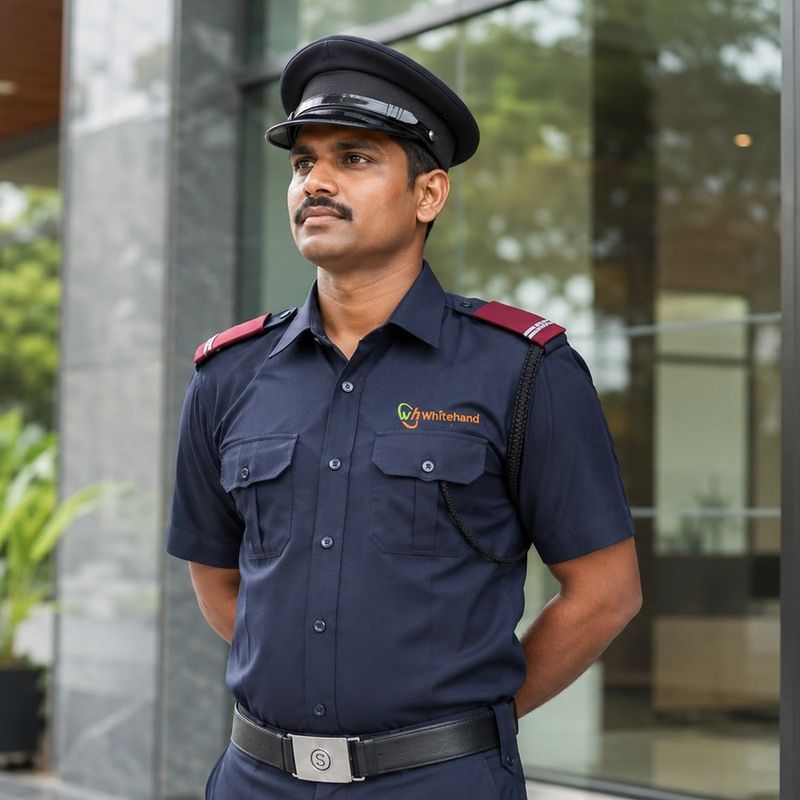
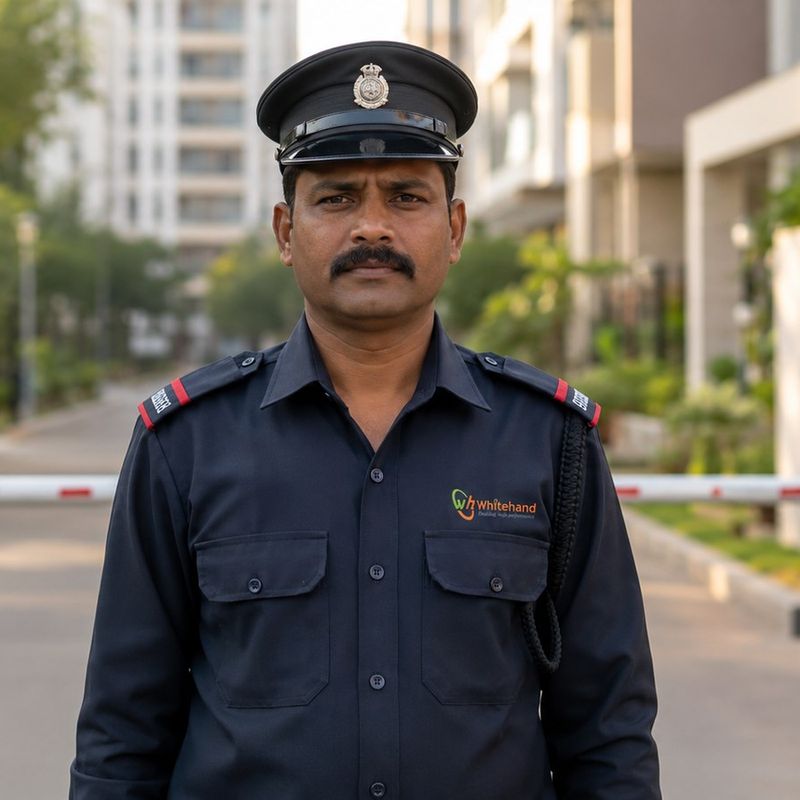
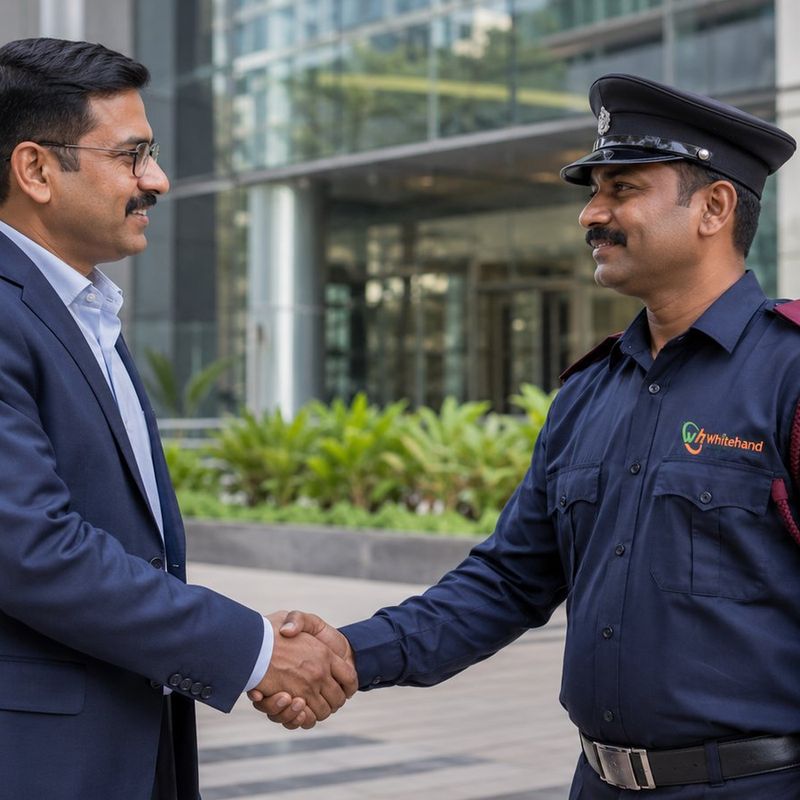
For apartments and gated communities specifically, Whitehand deploys police-verified, trained and uniformed guards under residential-specific standard operating procedures: disciplined gate and visitor management, delivery and domestic-staff control, scheduled patrolling of basements, terraces and amenities, and trained emergency response. Every deployment comes with a named supervisor and documented reporting the committee can review, and a one-hour replacement SLA so a post is never left empty. And where a community wants a single accountable partner, Whitehand combines security with housekeeping and support staff under one integrated facility-management contract, one manager and one point of contact. Explore all our security guard services.
Apartment and gated-community security across Bangalore
Whitehand deploys residential security teams right across the city, and we understand that a community in one micro-market has different demands from another. We secure apartments and gated communities in Whitefield, Electronic City, Marathahalli, Bellandur, Sarjapur Road, Koramangala, HSR Layout, JP Nagar, BTM Layout, Jayanagar, Banashankari, Bannerghatta Road, Kanakapura Road, Hosa Road, MG Road, Indiranagar, Rajarajeshwari Nagar, Hebbal, Yelahanka and Hennur. Whatever part of Bangalore your community is in, we can survey the site and deploy a compliant, right-sized team.
Frequently asked questions about apartment and gated-community security in Bangalore
What does an apartment security guard do?
How many security guards does a gated community need?
Is PSARA licensing required for residential security agencies in Bangalore?
How is residential security different from corporate security?
Can one agency handle both security and housekeeping for our society?
What should an RWA check before hiring a security agency?
How quickly can a replacement guard be deployed if one is absent?
Which areas of Bangalore does Whitehand cover for residential security?
The bottom line
For a Bangalore apartment or gated community, the right question is never who is cheapest, but who can prove PSARA licensing, police verification, real supervision, dependable replacement, and genuine residential experience. Staff to your actual gates and cover hours, insist on the compliance that protects your residents and your committee, and choose a partner who treats your community's safety as an ongoing responsibility, not a monthly invoice.
Related reading: how to verify a PSARA licence, how to choose a security guard agency in Bangalore, and in-house versus outsourced facility staff.