Office Housekeeping in Bangalore: Scope of Work, Staffing and Daily Checklist
A practical guide for Bangalore facility and admin managers: what office housekeeping should cover, a daily, weekly and monthly scope of work, how to size the team, the SLAs to put in writing, and a checklist you can use from day one.
Walk into any office at 9.15 on a Monday and you can tell, within a minute, how well its housekeeping is run. The reception glass is either spotless or smeared. The washroom either smells fresh or it does not. The pantry counter is either wiped or sticky from Friday. None of that is luck. It is the result of a written scope of work, the right number of trained people, and a supervisor who checks the work before your employees arrive.
This guide is for facility managers, admin heads and office managers in Bangalore who want to get that system right, whether you are writing a scope for a new vendor or tightening an existing contract. It covers what office housekeeping should include, a practical daily, weekly and monthly schedule, how to size the team, and the service levels worth putting in writing. If you are comparing agencies, read it alongside our guide to what office housekeeping costs in Bangalore.
What office housekeeping actually covers
The most common gap in Bangalore office contracts is a scope that simply says "cleaning of premises". That leaves every disagreement to be argued later. A proper scope breaks the office into zones, because each zone has different standards, frequencies and risks:
Reception and lobby. Your first impression. Floors, glass doors, the front desk, visitor seating and lift lobbies need attention before opening and touch-ups through the day as footfall builds.
Workstations and cabins. Desk surfaces, chairs, keyboards and phones (wiped with the right product, never sprayed directly), dustbins and the floor under and around each desk.
Meeting and conference rooms. Reset after every booking in busy offices: tables wiped, whiteboards cleaned, chairs aligned, cups and waste cleared.
Washrooms. The single biggest driver of employee complaints. They need scheduled cleaning several times a day, consumable refills, and a visible checklist on the door.
Pantry and cafeteria. Counters, sinks, appliances, tables and floors, plus food-waste handling that keeps pests away.
Common areas, stairs and lifts. Corridors, staircases, handrails, lift cars and lift buttons, which are among the most touched surfaces in any building.
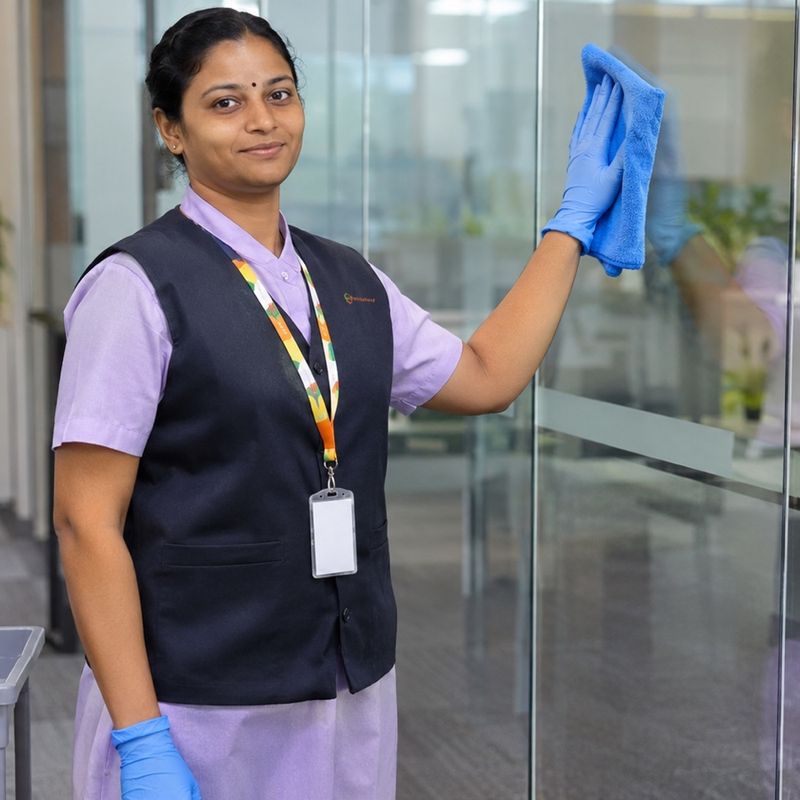
Glass and partitions. Internal glass walls, cabin partitions and window glass reachable without special access equipment.
Waste management. Collection from every bin, segregation into wet, dry and other streams as Bangalore's waste rules require, and moving waste to the designated collection point.
Basements, parking and outdoor areas. Sweeping, oil and stain removal, and keeping entrances, ramps and landscaped walkways presentable.
Write each zone into the contract with its own task list. It takes an afternoon, and it prevents most of the arguments that sour vendor relationships later.
The office housekeeping schedule: daily, weekly and monthly
Frequency is where scope becomes something you can check. Government and bank tenders, which are public, are a useful reference for how serious organisations specify this. One central government office tender required all daily cleaning to be finished by 9.00 AM, with staff then staying on site until 6 PM for hourly cleaning of toilets, the pantry and common areas. That pattern, a full clean before opening and scheduled rounds during the day, is the right model for most offices.
Daily tasks
Before opening. Sweep and wet-mop all floors, vacuum carpets, empty and reline every dustbin, wipe desks and meeting tables, clean the reception glass and front desk, and fully clean and restock every washroom and the pantry.
During the day. Washroom rounds at fixed intervals, pantry and cafeteria wipe-downs after each meal rush, meeting room resets, spill response, and disinfecting high-touch points such as door handles, lift buttons and handrails.
End of day. A final washroom and pantry round, waste moved to the collection point, and a check that the office is ready for the next morning's opening clean.
Weekly tasks
Dusting of high surfaces, cobweb removal, cleaning of internal glass and partitions, wiping light fittings and AC grilles, polishing furniture and cabinets, cleaning dustbins themselves (not just the liners), and a detailed clean of skirting, corners and behind furniture.
Monthly and periodic tasks
Machine scrubbing of hard floors, carpet shampooing, upholstery cleaning, high-level dusting of ceilings and ducts, deep cleaning of washroom tiles and grout, and coordination with your pest-control provider. External facade and high-rise glass cleaning is a separate, specialised job that needs trained staff and proper safety equipment, so treat it as its own line item rather than part of routine housekeeping.
Ask your vendor to submit the weekly and monthly calendar in advance, so your admin team knows which area is being deep cleaned on which day and can check it.
Washrooms and pantries: where offices are judged
Employees rarely notice a clean floor, but they always notice a dirty washroom. The offices that get this right do three simple things. First, they fix the cleaning frequency in writing: a full clean before opening and scheduled rounds through the day, more often on floors with high headcount. Second, they put a signed checklist on the washroom door, so every round is recorded with a time and initials and the supervisor can verify it. Third, they agree who supplies and tracks consumables such as hand wash, tissue and bin liners, so supplies never run out mid-afternoon.
Pantries need the same discipline. Food waste should leave the pantry several times a day, sinks and counters should be wiped after each rush, and the fridge should be cleared on a fixed weekly day. A neglected pantry is also the quickest way to invite cockroaches and rodents into an otherwise clean office.
How many housekeeping staff does an office need?
This is the question every facility manager asks, and the honest answer is that there is no single official ratio of staff to square feet. Area matters, but it is rarely the deciding factor. The things that actually drive headcount are:
Footfall and headcount. A 20,000 sq ft office with 300 people on site needs far more attention than the same space at half occupancy.
Number of washrooms and pantries. These are the most labour-intensive areas, and each one adds scheduled rounds through the day.
Operating hours and shifts. An office that runs from 9 to 6 needs a different deployment from a 24x7 operations floor that needs cover across three shifts.
Floor and surface types. Large areas of carpet, glass or natural stone take longer to maintain than vitrified tiles.
Cafeteria operations. A working cafeteria adds dedicated staff around meal times.
Mechanisation. Floor scrubbers and wet-dry vacuums let fewer people cover large open areas to a better standard.
For a sense of scale, the same public tender mentioned above asked for five housekeeping staff and one semi-skilled worker for an office of about 11,500 sq ft, working 8 AM to 6 PM. Treat that as one real-world data point, not a rule, because every office has a different mix of washrooms, people and hours.
Two details are often missed. You need relievers to cover weekly offs and leave, otherwise your posts sit empty one day a week. And once a site has more than a handful of housekeeping staff, a dedicated supervisor pays for themselves in consistency. The reliable way to get the number right for your office is a proper site survey, which any serious agency should do before quoting.
Mechanised cleaning: when machines beat mops
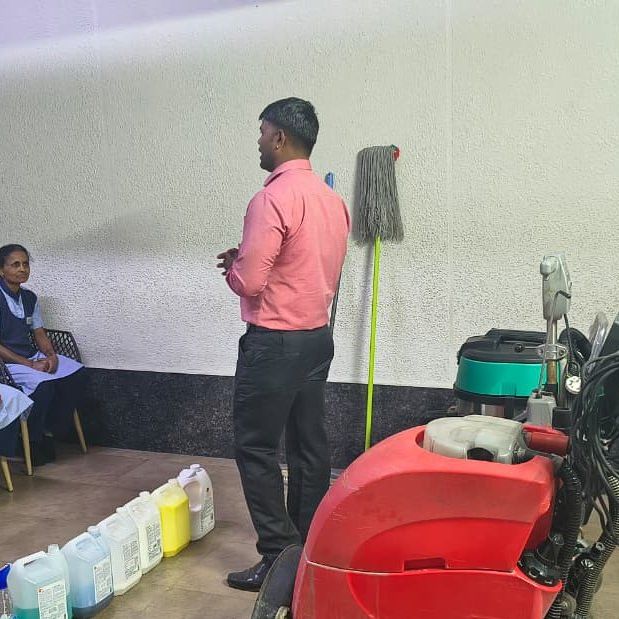
For large open-plan floors, lobbies, cafeterias and basements, the right machines improve both speed and results. Single-disc scrubbers and auto scrubbers clean hard floors more thoroughly than manual mopping and leave them drier and safer to walk on. Wet-dry vacuums handle spills and carpeted areas, and high-pressure washers make short work of parking areas and outdoor paving.
Machines only work in trained hands, though. Ask any vendor how their staff are trained on the equipment they bring, who maintains it, and whether the machines and chemicals are included in the monthly fee or charged separately.
Supervision, SLAs and reporting to agree in writing
A scope of work tells the vendor what to do. Service levels tell you whether they did it. The essentials to put in the contract are:
A named supervisor. One accountable person for your site, with a phone number your admin team can reach during working hours.
Attendance you can verify. Daily attendance shared with you, with agreed replacement when someone is absent so posts are never left empty.
Signed checklists. Washroom and zone checklists completed and signed on every round, available for inspection.
Response times. How quickly spills, washroom complaints and urgent requests are handled once reported.
Quality audits. Regular audits by the supervisor and periodic audits by the vendor's manager, with scores shared with you.
A monthly review. A short meeting to go through audit results, complaints, attendance and upcoming deep cleaning, and to agree corrective actions.
If a vendor will not commit to supervision and reporting in writing, that tells you how the contract will feel by month three.
Compliance: the part that protects your company
When you outsource housekeeping, your company is the principal employer under labour law. If the agency fails to pay minimum wages or deposit statutory contributions for the staff working in your office, the liability can come back to you. Before you sign, ask to see recent proof that the vendor is filing Provident Fund and ESI contributions for every deployed staff member, that wages meet the current Karnataka minimum wage, and that every person on your site has been background verified.
This is also why the cheapest quote is rarely the safest one. A rate that looks too good usually means one of these obligations is being skipped. Our comparison of in-house versus outsourced facility staff explains the cost and compliance trade-offs in more detail.
Consumables and equipment: decide who supplies what
Contracts often go wrong over small things. Decide upfront whether the vendor or your office supplies cleaning chemicals, tools and machines, and washroom and pantry consumables such as hand wash, tissue and bin liners. Public tenders handle this both ways: some make the contractor arrange all cleaning material, while others have the client supply consumables directly. Either model works, as long as it is written down, with brands or quality standards specified and a monthly consumption report so you can spot waste.
How to use this checklist with your vendor
Turn the schedule above into a one-page checklist for each zone, with columns for the time, the task and the initials of the person who did it. Ask the supervisor to sign each sheet daily and keep them for your monthly review. Within a few weeks you will know exactly which areas are consistently right and which need attention, and your conversations with the vendor will be based on records instead of impressions.
Before you shortlist anyone, it is also worth running through the five questions every facility manager should ask a housekeeping vendor.
Corporate housekeeping in Bangalore with Whitehand
Whitehand Services has delivered professional corporate housekeeping services in Bangalore since 2012, for offices, IT parks and commercial buildings. We have served 500+ facilities and completed 300+ housekeeping deployments. Every account gets trained, police-verified staff, a written zone-by-zone scope, a dedicated supervisor, daily checklists and regular quality audits, with ESI and PF compliance handled for every person we deploy. Where housekeeping is one part of a wider requirement, we can combine it with security and manpower under one contract through our integrated facility management service.
We provide office housekeeping across the city, including Whitefield, Electronic City, Koramangala, HSR Layout, Marathahalli, Indiranagar, Bellandur, Sarjapur Road, JP Nagar, BTM Layout, Jayanagar, Banashankari, Bannerghatta Road, Kanakapura Road, Hosa Road, MG Road, Rajarajeshwari Nagar, Hebbal, Yelahanka and Hennur.
Frequently asked questions about office housekeeping in Bangalore
What should an office housekeeping scope of work include?
How many housekeeping staff does an office need?
How often should office washrooms be cleaned?
What is the difference between daily cleaning and deep cleaning in an office?
Who supplies cleaning materials and consumables?
What compliance should I check before hiring a housekeeping agency?
Do you provide office housekeeping across Bangalore?
The bottom line
Office housekeeping is judged in small moments: a clean washroom at 4 PM, a reset meeting room before a client visit, a pantry that never smells. Those moments come from a clear scope, the right team size, real supervision and compliance you can verify. Put those four things in writing and your office will look the way it should every day, not just on the day the vendor was hired.
Related reading: housekeeping services cost in Bangalore, what to look for in a reliable commercial housekeeping team and in-house vs outsourced facility staff.